
Five best practices to create successful hybrid project teams
Flashback to February 2020, it’s Monday and you’ve woken up early to get dressed and get a head start on the 46-minute Monday morning commute to work. When you arrive to the office, your whole team is there! You walk over to one of your developers to get a quick update on a task, takes less than 5 minutes. You scheduled a meeting in the conference room so everyone can provide updates and brainstorm challenges, with their laptop lids closed. Memories, right?
Today is a very different reality, while the commute may be gone, that 5-minute walk over for an update is now a Teams message where you keep missing each other and takes more than 5 minutes for you to align and be available at the same time. That meeting that used to be in the conference room is now a virtual call, where you see no faces but can be pretty sure the participants are multi-tasking (working on other things) and not fully engaged. Even with some companies returning to the office (RTO), some team members may not come in on the same days, so hybrid teams are the new reality. As a project manager, you need to ensure that your team remains engaged with each other and that your projects stay on track.
Here are 5 ways you can set your teams up for remote success without becoming a micro-(project) manager.
Communication
With hybrid project teams, communication needs to be very detailed to be successful. Clearly communicating on a consistent basis allows you to set expectations and keep everyone connected and updated on the status of the project. Setting up your communication cadence is up to you and can vary depending on the kind of project you are running. If it’s a high priority item that has a lot of visibility from management and tight timelines, communicating once or twice per week with team members and stakeholders may work best.
Over communicating may result in team burnout or team members not fully internalizing your updates. Regularly check in with your team and stakeholders and adjust as needed. Status updates provide transparency on the project and keep everyone aligned on the current state and the remaining work. You may be running multiple projects at the same time; they may not all require the same level of communication. Here is where you need to evaluate based on priority, time to completion, and expectations of stakeholders.
Accountability
When working in person or remotely, there are times when tasks can get dropped and forgotten. Whether that’s due to lack of communication or complexity of the task. Accountability is an important factor to make sure everything stays on track. Every task should have a specific person accountable for it and they should be aware and acknowledge that they have an owner. It’s easy to assume that an unassigned task will eventually get picked up by someone, but it’s unlikely to happen unless you specifically assign a team member. Set clear project goals and expectations with everyone and reiterate every time you meet or send out updates to the team and/or stakeholders.
A big part of accountability is also ensuring that you regularly review progress towards those goals. Checking-in with team members regularly should be done to find out if there are any challenges they’re facing that can block progress and potentially delay the project. Setting milestones before the project begins is a great way to have a set check in point. Milestones serve as a clear target to work toward and showcases which tasks should be done by when in order to meet the overall goal.
Collaboration tools
Today, there is no shortage of collaboration tools available. Choosing the right tool depends on what your team is working on and the best medium to assign tasks and provide updates. With hybrid teams, not only can some members not be physically present, but they may also work across different time zones. It may not be feasible to meet with this team members on a consistent basis if the time zones are too far a part, but the ability to provide them, with a tool access to make their own updates and show progress, will go a long way in helping you manage calendars and keeping the video call meetings to essential syncs only.
When communicating make sure you choose one or two channels to avoid your team needing to go to multiple outlets to get updates. Keeping the communication medium consistent helps your team focus on what is important and to avoid tasks being missed. Whichever collaboration tools you decide to use for communicating, make sure that your team is able to access it and has the training on how to use it for updating their own tasks and progress.
Team syncs
For large project teams, having a regular one-on-one with each team member may be overwhelming to project managers and can be seen as a time sink by team members, especially if they are working on multiple projects. Schedule regular team meetings to keep the team connected, if your team is receptive, using video calls can help the meeting feel more personal. This should always be the choice of the team members but as the project manager you can lead by example and set expectations. Team syncs can be a great way to get everyone together and make sure there is alignment on the project.
Regardless of who is in the office, these meetings should always be virtual to be inclusive and accommodate all team members. Managing hybrid meetings means that you need to actively monitor the tools to make sure that there is equal participation from those online and those in the room. Recording the meeting or sharing the notes on changes and decisions is also a great way to remain inclusive. There may still be a need for one-on-one meetings with team members if challenges arise and you need more time to understand what is blocking them from completing a task. Schedule these as needed; you can always gauge your team for feedback on cadence. Additionally, you can also use these syncs to get feedback from the team on what’s working well and what can be improved.
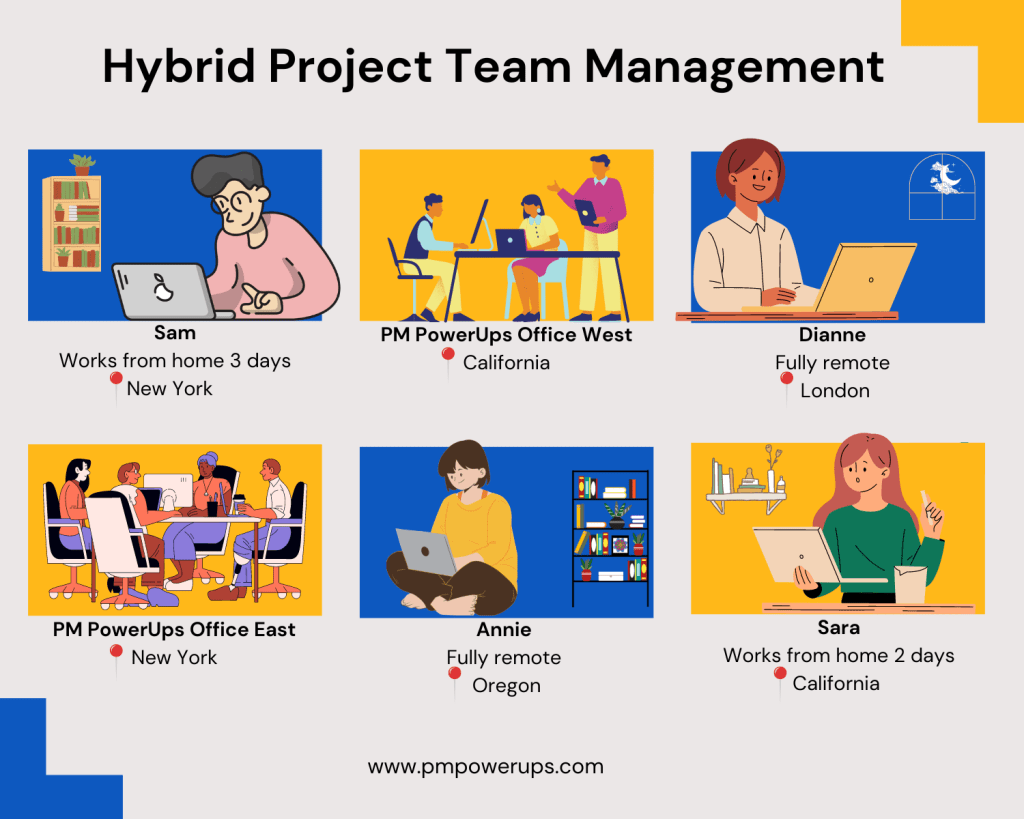
Flexibility
Every project and evert project team is made up of unique individuals. What works for one project may not work for another. A core skill for project management is the ability to adapt to changes and unexpected challenges. Your project team is comprised of unique individuals, each with their own strengths, work styles, communication, and schedule. As a project manager, it is important that you remain flexible with your options, especially with accommodating team members in different time zones. Flexibility with work hours and deadlines can accommodate differing schedules and keeps the project success on track. Talk to each team member and get to understand their needs and accommodations before starting a project. Remember, project management is a constantly evolving process, regularly check in with your team to see if any tweaks are needed throughout the project life cycle.
Bonus: Team culture
This is a challenge best practice for project managers with hybrid teams. Every team needs a culture and project managers should try to cultivate a sense of belonging and engagement among team members. Project managers should celebrate milestones and team members overcoming challenges. Project managers should also promote team identity and if possible, organize a virtual team-building event at the start of the project. This may be hard to do initially and time consuming, but building a successful project team requires a strong foundation of trust and fosters better collaboration.
Hybrid teams can seem like a challenge to manage but once you have a process, it works just as well, or even better, than in person project teams. Implementing these best practices can help project managers effectively manage hybrid teams and maximize productivity, collaboration, and team cohesion; regardless of where team members are located.
Communication is essential for hybrid teams, and project managers should use tools and channels at their disposal to provide frequent, clear, and inclusive communication among team members. When scheduling meetings, pay attention to schedules, time zones, and work arrangements. Be flexible with the team and be receptive to providing and receiving regular feedback.
Hybrid teams afford us the ability to expand our talent pool and retain top talent by remaining flexible. Trust is the foundation of hybrid teams, and project managers should foster a culture of trust and accountability among team members. Project managers should model trustworthiness, empower team members to make decisions, and avoid micromanagement. Managing hybrid teams has its challenges, but it’s not impossible to overcome. Integrating these tips these tips will help you learn how to successfully manage any hybrid team.
Did you find this article valuable? Stay up to date with more product management insights and resources by subscribing to our newsletter.
 PM PowerUps
Leave a comment