Four ways to measure customer sentiment
When you launch a new product (or feature), it is essential that you build in the right metrics to understand usage. It’s easy to gauge usage based on quantitative results like downloads, active users, or maybe even user engagement. But is that enough to know how your users feel about the product? Is your high usage because your product is amazing? Or is it high usage because your product successfully fills a unique gap? If it’s the latter, how easy would it be for a competitor to fill that gap and make it better? Without customer loyalty or promotion of your product, your customers remain susceptible to competitors who provide richer and more robust solutions. Every product has improvements that can be made, no product is perfect. However, understanding how your customers feel about your product can be tremendously helpful in identifying future feature improvements and enhancements to the product roadmap.
Measuring sentiment can be difficult, not just because it requires direct feedback from customers, but also because it can be fleeting. If you have an outage and measure sentiment, it will be low, because that’s how your customers feel at that moment. Measuring sentiment requires you to check-in with your customers on a regular cadence. To know if your product improvements are delighting your customers or not, it’s important to first develop a baseline, i.e., knowing how your customers feel about your product today. By setting a baseline, you can work on metrics like OKRs and KPIs to further improve and have a measurable impact. So, how can you measure customer sentiment? There are some tools available that can automatically do that for you, but depending on your time, budget and resources, there are a few other things you can do.
- Customer focus groups
- Net promoter score (NPS)
- User testing websites
- Customer social sentiment
Customer focus groups

What is it? This is a tried-and-true method of collecting feedback directly from customers. If you have direct contact with some of your customers, you can reach out to them and asking them how your product has been working for them. Customers love to give feedback and feel like they are part of the product-building process and are very receptive to providing constructive feedback.
How to do it? If you have direct contact with some of your customers, you can reach out to them directly to meet and have a casual conversation about your product. You can discuss where it meets their needs and where it could improve. If you do not have direct contact with any customers, reach out to your field sales team, let them know what type of feedback you are looking for and you can even mention specific size or type of customer to be more selective. Example of what a quick note:
” Hi Customer,
My name is Sam Green, Product Manager of X product and I am hosting a focus group with select customers. I would love to hear your feedback on how the product has been working for you, and what we can do to improve. If you have some time this week for a call, please let me know if any of the time slots below work with your schedule. “
Benefits: This direct feedback from customers gives you a better understanding of their business needs and real-world usage of your product. It provides you with in-depth insights and the unique opportunity to deep dive into your customer’s business needs, and perceptions about the product. This approach allows you to gain a more thorough understanding of complex issues that are harder to detect through metrics like usage or incidents. Focus groups can also be a great source of new ideas for features as participants bounce ideas off of each other and refine potential solutions.
Drawbacks: This process can be time consuming. Depending on your product or industry, some customers may not feel comfortable discussing their business with other customers present and may prefer one-on-one sessions. Another factor to consider with focus groups, is that there are usually customers that are more vocal than others so you may only get feedback from a few.
💡 – For focus groups or direct one-on-one with customers, it may be best to have a non-disclosure agreement in place in case you talk about future state of the products and to ensure customers are not sharing what others are doing outside of the discussion.
Net promoter score (NPS)
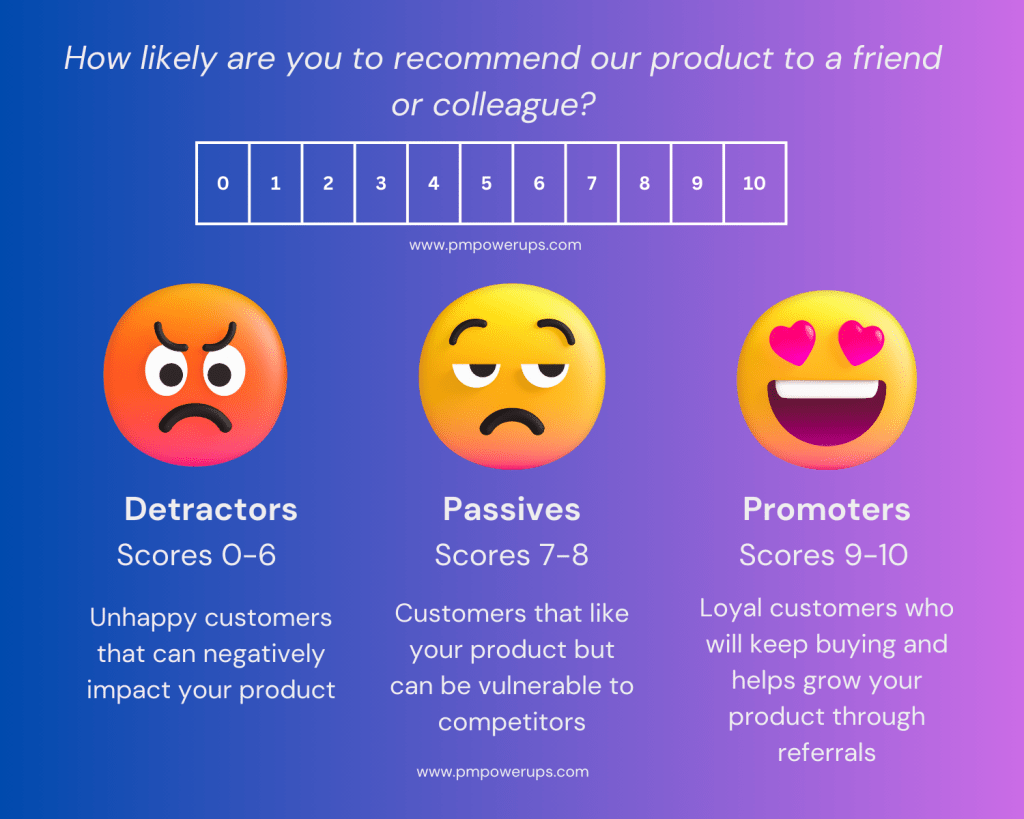
What is it? The Net Promoter Score (NPS) is a survey that goes to your customers that measures the likelihood of your customers recommending your product to others. The intent of the NPS score is to measure customer loyalty. It is measured by one question: “How likely are you to recommend this product to others?”. It is on a scale of 1 to 10, with 1 being least likely and 10 being most likely. The score is calculated by getting the total promoters of the product (people who answered with a 9 or 10) and subtract it from the detractors (customers who answered between 0 and 6). Those that score between 7 and 9 are not part of the equation.
How to do it? The NPS is one question survey so it makes it easy and more likely that your customers will answer it. You can do this by creating a form through any platform, (Microsoft Forms, Survey Monkey, Qualtrics) that is available through your company to ask the one question.
Benefits: Measuring customer feedback through surveys allows you to collect feedback from a wide range of customers. You will get hundreds of feedback (depending on product size) which would not be possible for you to gather if you tried to do focus groups with that many customers. It’s a fast method of measurement and gives you a great pulse on how your customers feel and can be measured over time.
Drawbacks: Surveys are a widely used method for collecting data, but there are some drawbacks. Surveys are limited in depth, there is only so much a number can convey. If a customer gives a score of 6, what does that really mean to you? Were they having issues with the product? Do they prefer another product? What is going wrong for them in their environment? That’s not something you can detect in a survey. You can attempt to get that message by adding an option survey question asking for additional feedback. While surveys can help you cast a wide net on customers, it can also lead to response bias where customers may respond with what they think you want to hear or even misunderstand the context of the question.
💡 – Surveys may also lead to ethical concerns. Customers may not be eager to provide personal information and be reluctant to respond. You must decide how much personal information you want to collect if any at all. If you do, collect personal information, make sure you are working with your privacy and legal teams on how to properly manage that data.
User testing websites

What is it? For in-depth customer insights, you can also leverage user-testing websites. These are dedicated websites that connect product teams directly with customers. These sites offer you the ability to do quick or in-depth customer sessions to meet and collect feedback.
How to do it? For customer testing of your product, you may be able to do this through your internal marketing team. Providing the team with the product or feature you’d like to get customer sentiment on, they can curate a list of customers that meet that criteria and connect you with them. If this is not something your marketing team offers, another method is using a dedicated interactive user testing website.
Benefits: This method helps you connect with customers you may not have been able to connect with before. You can specify your target audience and they will provide you with options based on your criteria. Taking it a step further, you can have these customers try out new products and features with interactive flows and see how your customers navigate and understand the product. It is a great measurement for user experiences and real-time watching customers interact with your product.
Drawbacks: Many of these sites offer payment to the customers as compensation for their time. This could be an additional cost to your organization for feedback. Additionally, this is a time-consuming process as someone needs to review the feedback from each customer.
💡 – Check with your company before signing up for interactive user testing, they may have licenses already enabled! Examples of sites that you can check out: UserTesting, trymata, userlytics
Customer social sentiment
What is it? No matter what product or industry you are in, everything has a social component to it or not. Whether you are on social media or not, your customers are. Customers may be using social media to express their love or frustration with your product, it is a new reality that we have to learn to manage and measure.
How to do it? This is hard to do, especially if you do not have a dedicated marketing team. If you have a marketing team, you can ask them to monitor your product sentiment on social media. Some companies have an overall social media presence and often get feedback about their products, sharing that feedback with the product team is the next step. If you do not have a large marketing team behind your product, there are other tools available to help you measure your customers’ social sentiment. You can also create your own social media accounts to interact with your customers directly.
Benefits: Understanding your customer social media sentiment allows you to see what your customers are saying in real-time. It may not all be frustrating but questions about your product that have not been clarified in your docs or may not be as intuitive as you think.
Drawbacks: Social media can be time consuming to go through and understand. It also has limited representation of your customers. You’ll often find the same users that are actively reporting on social media channels. Social media also offers a lack of context, with the limited character limits, it can be hard to understand where the challenges are for the customer without extensive engagement.
💡 – Check with your company to understand policies for signing up for social media accounts. Examples of sites that you can check out: Sprinklr, HootSuite, Seismic.
The ways to measure customer sentiment can vary depending on your product. Each method we discussed has its benefits and of course limitations, it’s entirely up to you to decide which method works best. By implementing multiple feedback methods, product managers can gather a comprehensive view of customer sentiment. Understanding how your customers feel about your product will help you make informed decisions and continuously improve your products to not only meet but exceed your customers’ expectations.
When gathering feedback, some of it can be a bit critical. The important part is to make sure the feedback is received assuming the best intention. Don’t take things personally, you learn more from the critical feedback and can take a challenge and turn it into an opportunity.
💡 Bonus: When you have gathered this feedback, it’s important to share with stakeholders. They may not have much time to fully analyze the data, but summarizing the data into an easy-to-read infographic can help you bring your team along in understanding the customer sentiment on the product.
Did you find this article valuable? Stay up to date with more product management insights and resources by subscribing to our newsletter.
 PM PowerUps
Leave a comment