Step by step guide to getting through your first 90 days
This post contains affiliate links
In a previous post, we discussed how important it is to navigate and curate a smooth onboarding experience. As a recent college grad, or a seasoned professional, when onboarding to a new company, you should always go in with a plan. The most important parts of onboarding include orientation, training, relationship building, goal setting, feedback, resources, and integration; all of which contribute to a successful and productive onboarding experience.
In this post, we will go into detail on how to create a 30-60-90 day plan when you onboard to a new role. A 30-60-90 day plan is a measurable outline of what you want to have accomplished within the first 30, 60 and 90 days of starting a new role. It is a valuable tool for onboarding, providing structure, clarity, and direction for new employees during the transition. If you’re unsure about where to begin to create this outline, let’s walk through an example for a mid-level Product Manager position at a tech company in their security division. Here’s an outline of the responsibilities from a recent product manager job posting:
Responsibilities
- Responsible for conception, design, development and delivery of our in-house security product and system.
- Develop product strategy and manage product planning, carry out market research and competitor analysis, to formulate product roadmap.
- Own the requirement management by collecting product requirements and understanding pain points from business teams and partnering teams, conducting requirement analysis, setting priorities, to fulfill business needs in a timely manner.
- Lead product design by preparing product requirement documents, designing product prototypes, driving collaboration with R&D, design and QA teams to achieve success.
- Perform metrics/KPI analysis to continuously improve the product; collect user feedback for product improvement and optimization.
💡Note: It is always a good practice to save the job description once you start a new role. It can be a helpful guide when updating your resume.
With that description, here’s how you can adapt those responsibilities into a detailed plan with potential targets and actions for each phase:
First 30 Days – Getting Acquainted and Planning
No one expects too much from new hires for the first few days so you should spend most of this time completing required training and familiarizing yourself with the company and your product. Shadowing your peers will help you expedite your onboarding process with hands-on experience.
Week 1-2: Understanding the Organization and Team
Targets:
- Establish a solid understanding of the company’s mission, values, and culture.
- Build relationships with key team members and stakeholders.
- Familiarize yourself with the existing security products and services.
Actions:
- Meet with team members individually to learn about their roles and responsibilities.
- Attend company orientation sessions and security team meetings.
- Review existing security documentation and product materials.
Week 3-4: Assessing the Current Situation
Targets:
- Identify any immediate challenges or gaps in the security product and system.
- Begin gathering feedback from business and partnering teams.
Actions:
- Conduct initial interviews with key stakeholders to identify pain points and opportunities. Get an understanding of customer sentiment about the product.
- Perform an initial assessment of the product’s performance and metrics.
- Start building a list of potential improvements.
Days 30-60 – Setting the Foundation
In your second month of the job, you should have gained a better understanding of your product and be able to assess how it’s working for customers today. You may get the opportunity to talk to customers at this point and should be able to identify areas of improvement.
Week 5-6: Defining Your Vision and Strategy
Targets:
- Develop a clear vision for the security product and system.
- Create a high-level product strategy and roadmap.
Actions:
- Analyze market trends and conduct competitor analysis.
- Hold brainstorming sessions with the team to define the product vision.
- Draft a preliminary product strategy and share it with stakeholders for feedback.
Week 7-8: Requirements Gathering and Planning
Targets:
- Establish a structured process for collecting and prioritizing product requirements.
- Begin outlining a detailed product plan for the upcoming months.
Actions:
- Collaborate with business teams to gather detailed product requirements.
- Use feedback from stakeholders to refine the product roadmap.
- Work with cross-functional teams to plan development cycles and milestones.
Days 60-90 – Executing and Optimizing
In the third month of your transition, you should be on your way to executing design specs and working with stakeholders. It’s fine if you do not know every detail of the product, but asking questions, collecting feedback, and developing a plan, will help you gain the knowledge you need to refine your proposals.
Week 9-10: Product Design and Collaboration
Targets:
- Develop comprehensive product requirement documents.
- Initiate the design phase in collaboration with R&D, design, and QA teams.
Actions:
- Create detailed product requirement documents, including user stories and specifications.
- Work closely with the design team to ensure a user-friendly and efficient product design.
- Engage with R&D and QA to kick off development and testing processes.
Week 11-12: Monitoring and Improvement
Targets:
- Start measuring key metrics and KPIs for the product’s performance.
- Collect user feedback and identify areas for improvement.
Actions:
- Implement tools and processes for tracking product metrics.
- Solicit feedback from early users and stakeholders.
- Begin making iterative improvements based on feedback and data.
Beyond 90 Days – Long-Term Goals
Targets:
- Continue to refine and enhance the security product.
- Establish yourself as a trusted leader within the Security Engineering team.
- Strengthen relationships with key stakeholders across the organization.
Actions:
- Maintain regular communication with cross-functional teams and stakeholders.
- Iterate on the product strategy based on ongoing market analysis and user feedback.
- Seek opportunities to contribute to the broader security initiatives of the company.
This may seem like a lot of information but in the chaos and challenges of transitioning to a new role, having a plan of action for the next steps you need to take makes it more manageable. Creating this plan in a PowerPoint-like format is also a best practice when creating the outline. This may be a better option when sharing your plan with your manager since it is easy to follow along and provide feedback. If you are more of a visual reader, here’s a visual example of what this may look like in presentation format below:
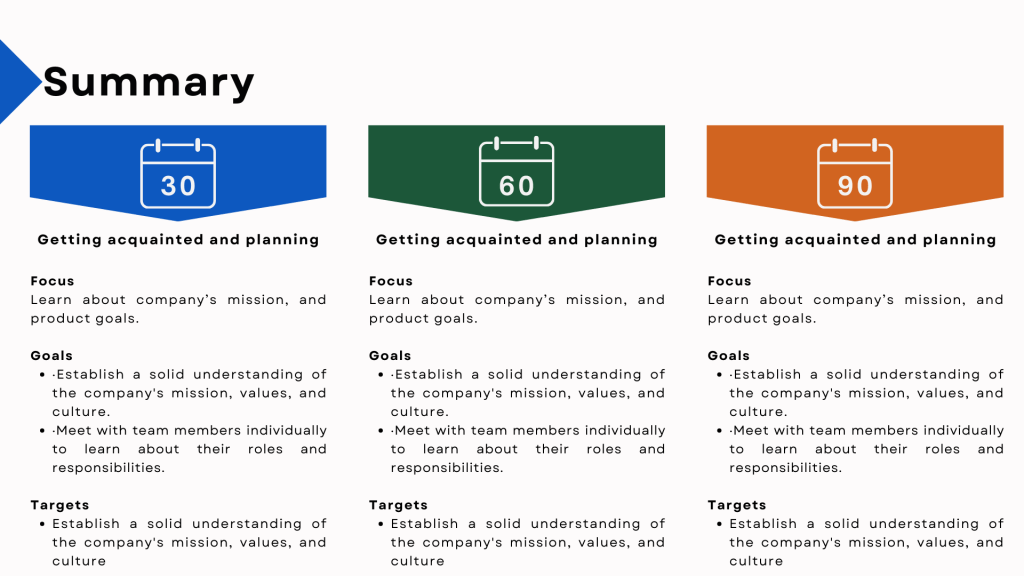
Template with more details available here.
Setting up a 30-60-90 day plan is important for many reasons; it helps you with goal setting, accountability, communication and makes it easier for your performance evaluation. Yes, even in those early days, you are being evaluated on your performance, whether you can make an impact immediately or not; that’s usually not the expectation. You will be evaluated based on how you manage navigating the company and how you plan on developing in the role.
A great resource that can help you with creating this plan is The First 90 Days by Michael D. Watkins. In his book, he writes extensively about best practices and proven strategies that can help you get started in your new role in a fast and efficient way. Watkins walks his readers through various transitions scenarios and brings attention to some common missteps that can happen and how to navigate through them.
Usually job descriptions are vague, you’ll learn more about the role when you join, and work with team members. As you get more information about what is expected of you in the new role, adjust your plan accordingly. Remember that this plan is just a guideline, and you should be flexible in adapting it to the specific needs and challenges of your role. Regularly review and adjust your plan as you gain more insights and experience within the organization. Let your teammates and manager review your plan to make sure that your priorities align.
Did you find this article valuable? Stay up to date with more product management insights and resources by subscribing to our newsletter.
 PM PowerUps
Leave a comment